Friday, 20 February 1925
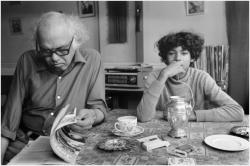
Image by George Hallett
Justin Alexander la Guma was born in District Six, Cape Town, on 20 February 1925. His father, Jimmy La Guma, was of Cuban descent, which made him a person of mixed race in South Africa and he was classified as Coloured. La Guma’s father was involved in anti-apartheid activism, a path that he would also follow. La Guma was a talented writer and wrote several books, most of them depicting the plight of black people under apartheid. He was arrested several times as an activist, and would use his time in jail to write. He later went to exile in England before returning to his father’s native country, Cuba, where he became an African National Congress (ANC) representative. He died in 1985.
Tuesday, 20 February 1940

Dr Abdullah Abdurahman, medical doctor and Cape community leader, died on this day at the age of 69. Founder and leader of the anti-apartheid African People’s Organisation (APO), he was the first non-White to become a member of the Cape Town City Council (from 1905-1940).
His death raised concern within the Black, Coloured and Indian communities, as he was a well-known human rights campaigner. The Standard and Imvo Zabantsundu (Black Opinion) hailed him as a great leader who was at all times available to address the needs of Black, Indian and Coloured communities.
Some tributes to Abdurahman also came from unexpected sources such as from General J.B.M. Hertzog and General J.C. Smuts. In June 1999, President Nelson Mandela posthumously honoured Abdurahman by awarding him the Order for Meritorious Service: Class I (Gold).
Wednesday, 20 February 1946
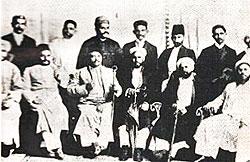
A Day of Prayer, called by Natal Indian Congress (NIC), was widely observed. Indian businesses were closed at 13:00 and many Indians took a resistance pledge. Messages such as “After all civil resistance had its birth in Asia” and “Jesus was an Asiatic; if he was reborn and went to South Africa today, he would have to live in a ghetto” were put on display by protesting Indians.
Monday, 20 February 1950
The Population Registration Bill was read for the first time in Parliament. The Bill was a cornerstone of the Apartheid policy as it recognised three race classifications, namely White, Coloured and Native (Black). Indians were initially classified as Coloureds until a fourth racial group was added later. An office of race classification was set up to oversee the classification process. The Population Registration Act (No. 30 of 1950), promulgated on 7 July 1950, made the Group Areas, Immorality and Mixed Marriages Acts possible.
Friday, 20 February 1970
On 20 February 1970, the Springbok rugby team was presented with the State President Sports Award. The event took place in the Lady Ann Barnard Room at the Castle, presented by the State President J.J. Fouche. It is significant that the award was made at the time when South Africa was barred from taking part in international sports competitions, including rugby.
The award was handed to Corrie Bornman, Springboks’ team manager. It was in the form of a medal framed with a certificate. The award was then taken to South African Rugby Board (SARB) headquaters to be displayed. It was presented to the team in recognition of the dignified, sportsmanlike and disciplined manner in which the players conducted themselves. At that time, the Minister of Sport was Frank Woring. It is unclear how these merits of the rugby team were determined, considering the fact that the Springboks hardly played against any international opposition.
Saturday, 20 February 1971
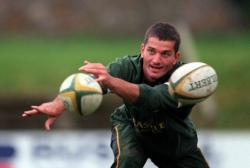
Former rugby player, Joost van der Westhuizen, was born on 20 February 1971. Van der Westhuizen was at the height of his career during the mid 1990s and early 2000s. He played in the 1995, 1999 and 2003 Rugby World Cup. He retired from professional rugby after the 2003 World Cup. At 89 caps, he held the record for the most capped Springbok of all time at the time of his retirement, and had scored 38 tries.
Van der Westhuizen was later on diagnosed with motor neuron (Lou Gehrig’s) disease. He died on 6 February 2017.
Friday, 20 February 1981
The homeland known as Ciskei, between the Fish and the Kei River, was created between 1961 and 1982 by the then Nationalist Party Government. This was done as part of the Government’s plan to further its programme of Apartheid by excluding the majority of Black South Africans from South Africa. The Bantustans would then function as labour reserves for white South Africa. It is estimated that over 300 000 people were forcibly removed to Ciskei between 1970 and 1982.
The establishment of the homelands also went hand in hand with a stricter enforcement of Pass laws. Ciskei was declared a self-governing territory in 1972. The Chief Minister of the time was Justice Mabandla. While Botha may have announced that Ciskei would be independent on the 4 of December 1981, in reality Ciskei only became ‘independent’ from South Africa in December 1982.
Monday, 20 February 1984
Sydney Vernon Petersen, one of the prominent South African poets and educationist of the 1940s, died in Germiston. His poetry was translated into English, Italian, Russian and German. In 1946 Petersen published a highly acclaimed novel, As die son ondergaan (When the sun sets). Although his profession was teaching, it was as a poet that Petersen became famous. He traveled extensively internationally as a guest speaker. Various honours were bestowed on him during his lifetime and posthumously.