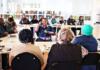
Finance Minister Malusi Gigaba was at pains to point out on Wednesday that a one-percent VAT increase, the first in 25 years in South Africa, should not be considered a blow to the country’s poor majority.
“VAT has the least effect on the poor” compared to other tax hikes the National Treasury could have introduced, the minister told a media briefing shortly before he tabled the 2018 budget.
He said the increase was off-set by more social spending, including the introduction of fee free tertiary education for first-year students from poor and working class households and the piecemeal introduction of the National Health Insurance.
Gigaba said the measures were not aimed at creating a populace dependent on welfare, but would, coupled with the introduction of the national minimum wage in May, help the poor to uplift themselves. Unemployment was lowest among that sector of the population that had tertiary qualifications, and therefore free higher education should in the long run help curb joblessness.
“So the pain is only transitory. All of these are aimed at boosting the economy and freeing the poor from unemployment.”
Gigaba also remained firm that South Africa could not afford to embark on a nuclear power expansion programme, adding that for the moment the country’s new coal-powered stations provided adequate supply.
“Since the statement by the president in Davos, nothing has changed … We cannot afford it,” he told a media briefing shortly before tabling his 2018 budget to parliament.
Gigaba was referring to remarks made by then deputy president Cyril Ramaphosa at the World Economic Forum last month.
Gigaba was responding to a question on why the budget made no provision for new nuclear plants, a policy drive of Jacob Zuma, who made way for Ramaphosa as president last week.
He also said government needed to implement further measures to contain the public sector wage bill, which to date, had “crowded out spending in other areas”. , the 2017/18 budget review tabled by Finance Minister Malusi Gigaba in Parliament on Wednesday said.
“Government is working to ensure that the current wage negotiations process results in a fair and sustainable agreement,” Gigaba said in his speech to the National Assembly.
“This process will require careful consideration from all stakeholders.”
Currently government was relying on the freezing of posts and on retirement to curb its spending on wages, which makes up 35.2 percent of total government spending.
African News Agency (ANA)
Date:
VAT ‘no punishment for the poor’
Finance Minister Malusi Gigaba, delivers the Budget Speech yesterday.